A trigger is defined by a set of conditions which, when they are confirmed, potentially cause the automatic creation of a work order by CARL Source.
Triggering condition
There are three types of trigger condition:
- Calendar
- For a measurement reading
- For symptoms
Only one needs to be confirmed in order to trigger the associated job; see Simulation and Launching of work order plans.
Calendar triggering
The trigger corresponds to a frequency at which work must be performed.
This may be, for example, an annual overhaul such as for heater maintenance.
In this case it is possible to specify:
- The interval: the time lapse between 2 triggers,
-
The first trigger date (work order plan template) which will depend on the date of the next launch when the work order plan template is associated with the equipment (generally upon creation of the equipment):
- Either in the form of a date (day/month)
- Or a number of days.
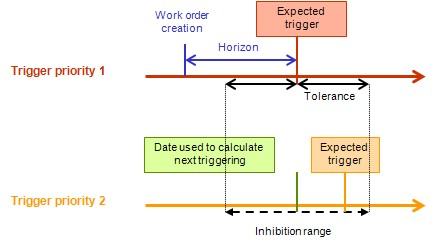
- The tolerance: number of days before and after the trigger, during which the current trigger will be inhibited if a higher priority trigger is triggered.
- The horizon: the number of days between the creation of the work order and the date scheduled by the trigger.
Tolerance example:
If a priority 2 trigger has a next launch date between 29 April and 7 May,
a trigger with a priority of 4 and a tolerance of 4 days, scheduled for 3 May, will be fictitiously triggered.
Horizon example:
the trigger date is 3 May and the horizon is 10 days
→ The work order will be created automatically on 23 April, with a start date of 3 May.
Illustration for two triggers of the same plan
Triggering upon measurement reading
The value reached by a reading point triggers work order plan jobs; see Taking a measurement reading.
If the value is not known, it can be extrapolated using the average ageing; see Reading point [General].
This can be a kilometer counter, in which case it is an interval trigger, or a temperature, in which case triggering is conditional upon a value range.
In this case the trigger is defined by:
- The reading point in question,
- The type of value verification: range, minimum or maximum value, periodic value.
- The tolerance: same principle as for a calendar trigger, but applied to measurement units.
Symptom trigger
The trigger is enabled when the symptom is declared in the form of an Equipment event and under the following conditions:
- The "last planned implementation" and "last implementation" dates are both known or unknown,
- The date of the event is:
- after the last implementation date of the trigger,
- included in the seasonality interval of the trigger (if it is defined).
Updating
Updating determines the date or measurement used to calculate the next trigger:
- Upon triggering
The date/measurement of the next trigger is calculated in relation to the planned trigger date/measurement, even if the job has been moved in time. This corresponds to a "fixed date" triggering for a calendar trigger. - On implementation
The next trigger is calculated in relation to the date or value of the reading point, at the time of closure, cancellation, or deletion of the work order corresponding to the trigger.
This can consequently cause a shift in the trigger dates.
Updating of other triggers
With this option, when this trigger disables the action of a lower-priority trigger, the next date of the disabled trigger will be calculated in relation to the date of the disabling trigger (if the disabled trigger is set to be updated by the other triggers).
Updating by other triggers
With this option, when the action of this trigger is disabled by a higher-priority trigger, the next trigger date will be calculated in relation to the date of the disabling trigger (provided that the option chosen for the latter trigger is to update the other triggers).